Education · Study-based orientation · for your dog's gut health
Study-based gut health tool

How it works: Gut Health Study Comparison

A disturbed gut is not a uniform condition. The tool distinguishes twelve gut condition profiles that are based on different biological mechanisms. Scientific studies therefore investigate different diagnostic procedures, substances, quantities and application periods depending on the condition.

In the study comparison you select which symptoms, illnesses, medications, dietary factors and further characteristics are to be taken into account. The selection is compared, based on fixed rules, with characteristics and influencing factors described in scientific studies on the twelve gut conditions.

You receive a compiled study report with comprehensible characteristic matches, understandable explanations of mechanisms, investigated substances and quantities, diagnostic procedures as well as the underlying study sources.

Start gut health study comparison →
Process

How the study-based gut health tool works.

01
Questionnaire
You choose which symptoms, conditions, medications, dietary factors and other characteristics are to be taken into account in the study comparison. It takes about four minutes and needs no registration.
02
Rule-based study comparison
The selected information is compared automatically and according to fixed rules with characteristics and influencing factors described in scientific studies on twelve different gut conditions.
03
Characteristic matches
You find out which of your details match the characteristics of the twelve gut conditions described in studies, which do not match and which are still open. So you can see at a glance which study profiles fit your details.
04
Compiled study report
The report explains possible biological mechanisms and names procedures, substances, amounts and periods of use from the studies. All sources are given with study type and DOI so that you can read them yourself.
What the study report contains

Not just study results – also understandable context.

The report shows which of the details selected for the study comparison match characteristics and influencing factors described in scientific studies on twelve gut conditions. It explains possible biological mechanisms, names diagnostic procedures used in studies and shows which substances or preparations were investigated under which conditions.

Mechanismus-Illustration eines Darmzustands
Gut condition profile and possible mechanism
Which biological processes are described in studies?
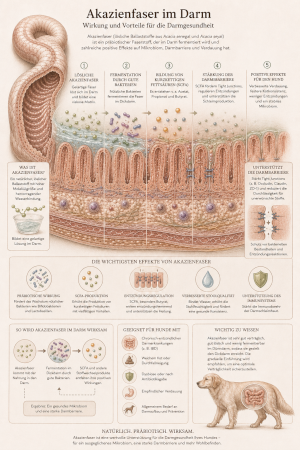
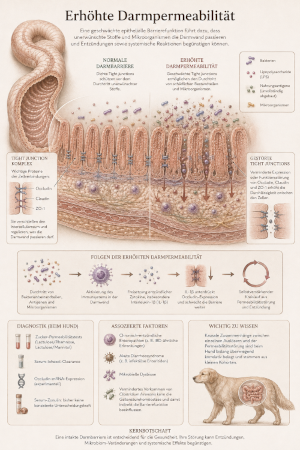
For every gut condition profile shown, an understandable illustration presents which biological processes, influencing factors and changes or complaints were described in the evaluated studies. The illustration shows a simplified possible mechanism based on the studies. It does not represent an individual finding and does not confirm that the gut condition shown is present in a particular dog.
Illustration des Wirkmechanismus
Mechanisms of action of investigated substances
Which substances were investigated – and which results were observed?
For every substance or preparation shown, the report indicates in which studies it was investigated, which biological mechanisms of action were described there and which changes or endpoints were observed. The presentation reproduces the results of the respective studies. It does not permit any statement as to whether the substance or preparation concerned is suitable, effective or safe for a particular dog.
Quantities and application periods
Specific study data instead of general rules of thumb
The report shows which quantities, application periods and dosage forms were used in the underlying studies. In addition, the species investigated, the study population and key limitations of the respective study are stated. If a study used a quantity related to body weight, its arithmetic equivalent for the body weight entered can be displayed. This conversion transfers the mathematical study figure only. It does not take into account any individual illness, medication, interaction or tolerability and is not a dosage or application recommendation.
Quantity used in the study per kilogram of body weight and day
Investigation period in days or weeks
Veterinary check before every application
Logic of the report
Selected detail → study characteristic → possible mechanism → study finding
Every study report follows a transparent logic: first it shows which selected details match characteristics or influencing factors described in scientific studies on the twelve gut conditions. The report then explains the associated possible mechanisms and shows which substances or preparations were investigated in the linked studies, which results were observed and which limitations were documented. The characteristic matches are neither a probability of disease nor a diagnosis. The assignment cannot be used to derive whether a particular gut condition is actually present, what causes complaints, or which measure, quantity or duration of use is suitable, effective or safe for a particular dog.
Why Scientific?

Every study-related statement is assigned to the source it is based on.

For the rule-based comparison we record and structure scientific studies on twelve gut conditions. Supplementary specialist literature is used exclusively to explain and visualise biological relationships in an understandable way. It is not included in determining the characteristic matches or in assigning investigated substances and measures. For study-related statements, the study report refers to the respective underlying sources and states the DOI, where one has been assigned. Study type, species investigated, study population, quantities and application periods used, results observed and key limitations are presented separately.

Recorded and evaluated scientific studies mehr als 700
Data status stated in every report
List of sources included in every report
Study type and species investigated stated for each source
Putting the study report in context

Understanding study results and using them responsibly.

The report compiles scientific studies on the selected symptoms, illnesses, medications, dietary factors and further characteristics in a structured way. It shows characteristic matches, possible biological mechanisms as well as substances, quantities, application periods and diagnostic procedures investigated in the underlying studies.

The content serves as information and as a basis for further consideration. It does not constitute a veterinary diagnosis, an individual treatment recommendation or any statement about the suitability or safety of a measure for a particular dog.

In the case of complaints, illnesses, administration of medication or before using any listed substances and quantities, a veterinary assessment is required.

Create study report
SOURCES Study sources and DOI details directly in the report
TRANSPARENCY Study type, species, population and limitations stated
LANGUAGES Available in German, English, French, Spanish, Italian and Portuguese

Note: The study comparison shows characteristic matches with gut condition profiles described in scientific studies. The number or order of the matches is neither a probability of disease nor a diagnosis. The study report reproduces study information and does not determine which measure, quantity or duration of use is suitable, effective or safe for a particular dog.

Medication must not be started, changed or discontinued on the basis of the study comparison. Individual suitability, safety and tolerability must be assessed by a veterinarian. In the case of health complaints, acute changes or a deterioration in your dog’s condition, please consult a veterinarian.

Start gut health study comparison →