Education · Study-based orientation · for your dog's gut health
Knowledge · free

Gut, nutrition, defences:
how it all fits together.

Whatever a dog eats ends up in the gut. Trillions of bacteria live there, and a large part of its defences is located there. Understanding this interplay means understanding a lot about your dog's health.

Here you will find the overview first. Each of the four sections has its own page with all the details.

The four sections

Each section passes something on to the next.

Nutrition

Nutrition

What ends up in the bowl feeds the dog – and its gut bacteria.

  • The dog absorbs protein and fat itself in the small intestine. They provide energy and the building material for every cell.
  • The dog cannot digest fibre itself. It travels on to the large intestine, where it feeds beneficial bacteria.
  • A ration calculated to meet requirements provides enough of everything and too much of nothing.
More about nutrition →
Gut

Gut

The gut wall is the border between outside and inside. Bacteria help to guard it.

  • The gut wall is only a single cell layer thick and renews itself completely every few days.
  • A mucus layer keeps the bacteria at a distance from the wall. This protects the gut cells.
  • Beneficial bacteria turn fibre into butyrate. This is the most important source of energy for the gut cells.
More about the gut →
Immune system

Immune system

The immune system consists of immune cells. In the gut they learn to tell friend from foe.

  • The immune cells share the work: sentinel cells recognise intruders and pass the message on. Phagocytes take up germs and cell debris. B cells form antibodies that specifically mark germs. T cells direct the response and remember pathogens.
  • A large part of these immune cells sits in and beneath the gut wall. There they learn to tolerate food and beneficial bacteria and to fight pathogens.
  • If telling them apart fails, a false alarm occurs – for example a food allergy.
More about the immune system →
Health & recovery 1234

Health & recovery

When the interplay is right, you can see it in digestion, skin, coat and energy.

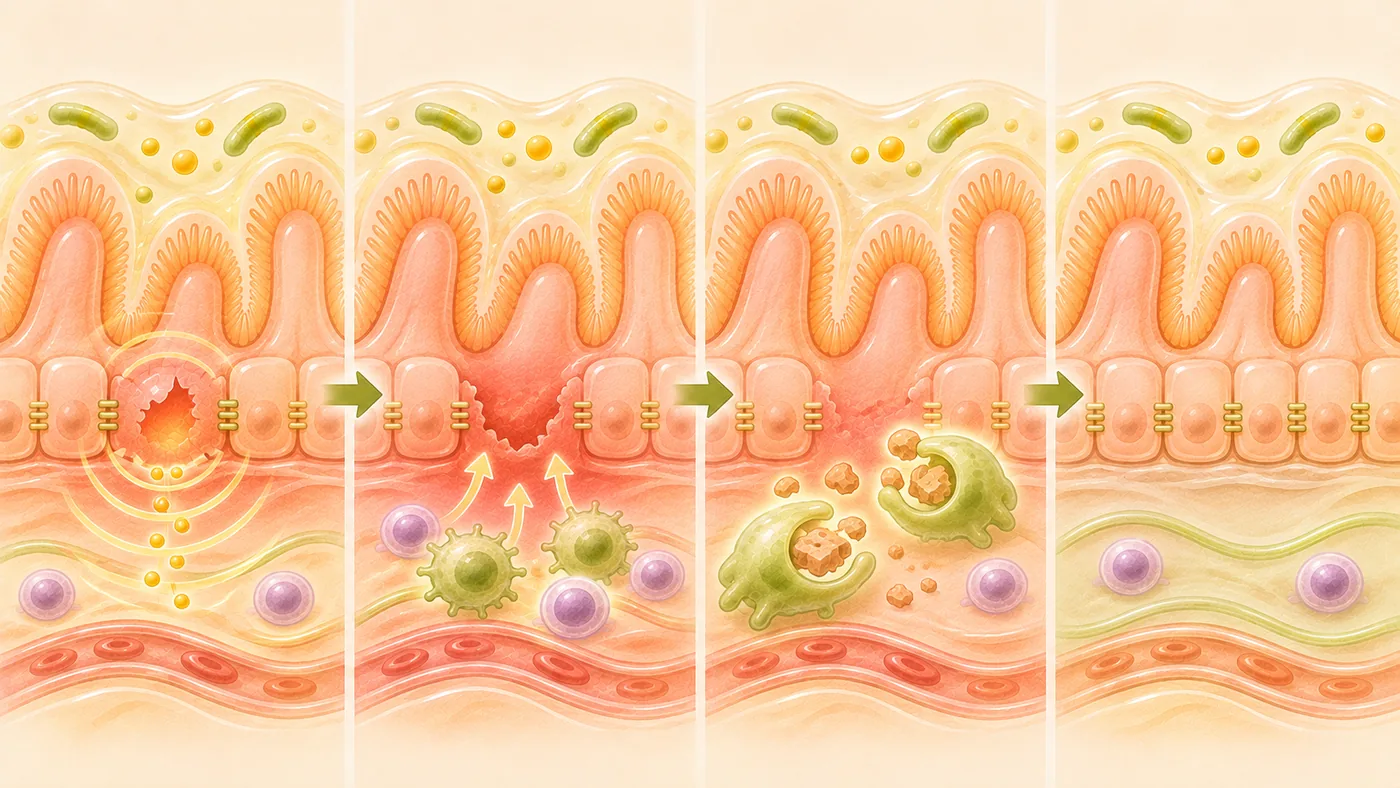
And when something is damaged, the body repairs it itself – directed by the immune cells. Whether infection, minor injury or irritated gut wall: repair takes place in four phases.

  1. 1Alarm damaged cells and sentinel cells release messenger substances. Blood flow to the area increases, it becomes warm, red and swollen. This is inflammation – and here it is useful.
  2. 2Defence phagocytes migrate in from the blood and fight the germs that have entered. Antibodies mark the germs so they are found more quickly.
  3. 3Clean-up large phagocytes take up germ remains and dead cells. Then they switch over and give the signal to end the inflammation.
  4. 4Renewal new cells grow back and close the gap. In the gut wall this happens particularly quickly, because it renews itself every few days anyway.

It is good when the programme ends after a few days. It becomes unfavourable when switching off does not work: then the inflammation persists and becomes chronic.

More about health and recovery →

Gut & immune system at a glance

A healthy and a disturbed gut compared.

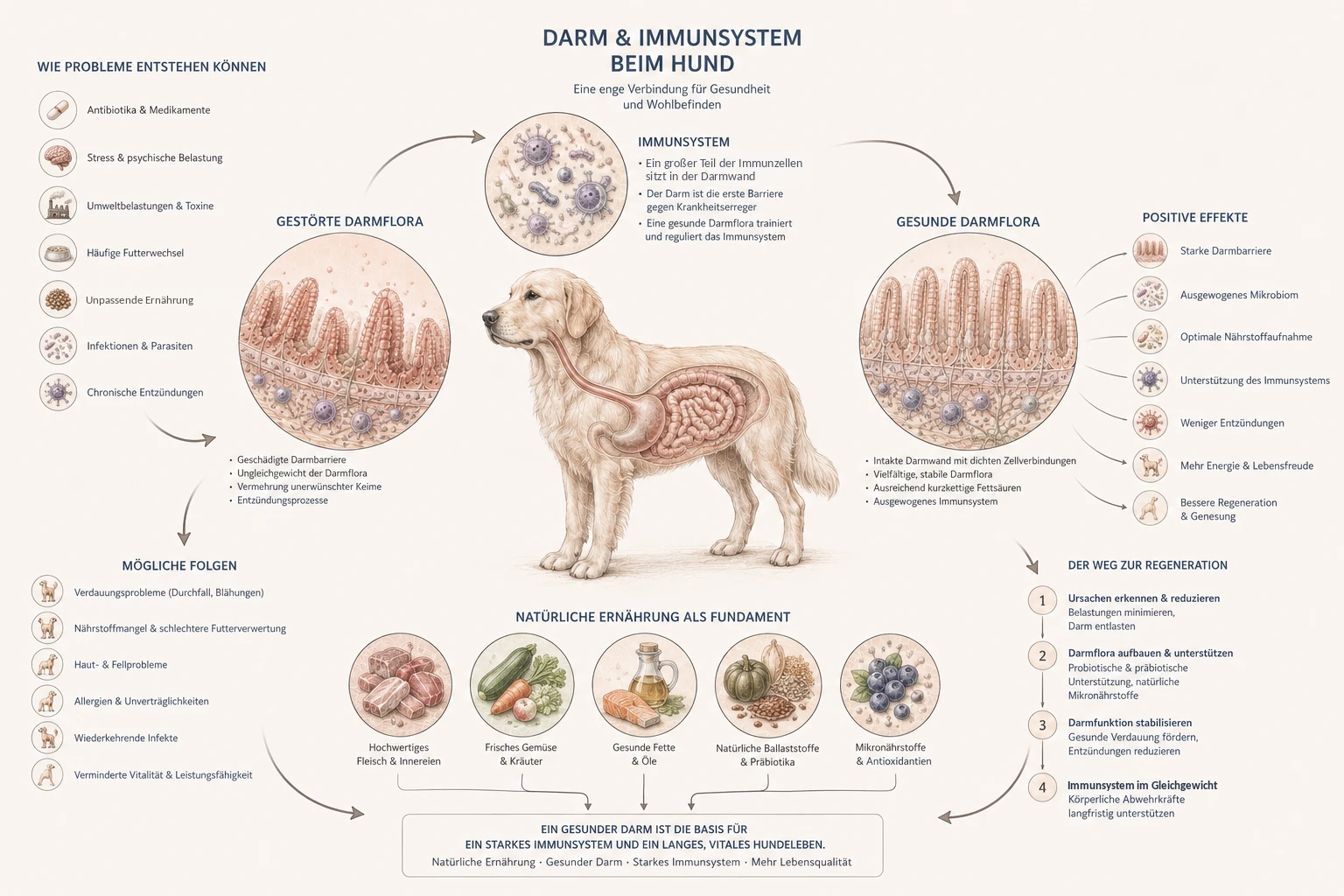
The drawing sums everything up: on the left a disturbed gut with causes and consequences, on the right a healthy gut and its benefits, at the bottom nutrition as the foundation. Below it, the key points are listed again to read.

Drawing: gut and immune system in dogs – disturbed and healthy gut flora, causes, possible consequences, nutrition as the foundation and the way back into balance Enlarge ↗

When the gut is in balance

  • The gut cells fit tightly together. Germs and harmful substances stay outside.
  • Many different types of bacteria keep each other in check.
  • The bacteria supply enough butyrate. The gut cells have the energy to renew themselves continuously.
  • The defences stay calm and react only to real dangers, not to food.
  • What is in the food reaches the body.

When the balance is disturbed

  • Gaps form between the gut cells. Germs and food components get into the gut wall.
  • There are fewer types of bacteria. Unwanted germs can multiply.
  • The defences are constantly on alert. Inflammation subsides less well.

What can disturb the balance

Antibiotics and other medicinesInfections and parasites such as Giardia or wormsStressAbrupt changes of foodUnbalanced or unsuitable nutritionChronic diseasesEnvironmental pollutants

How you may notice it

Diarrhoea, soft stools or flatulenceSkin and coat problems, itchingAllergiesRecurring infectionsLess energy and appetite

The example below shows how the gut finds its way back into balance. ↓

An example many people know

The gut after antibiotic treatment

Almost every dog receives an antibiotic at some point. This example shows how the four sections work together – and how the body protects and repairs itself.

  1. An infection is treated

    An infection is treated

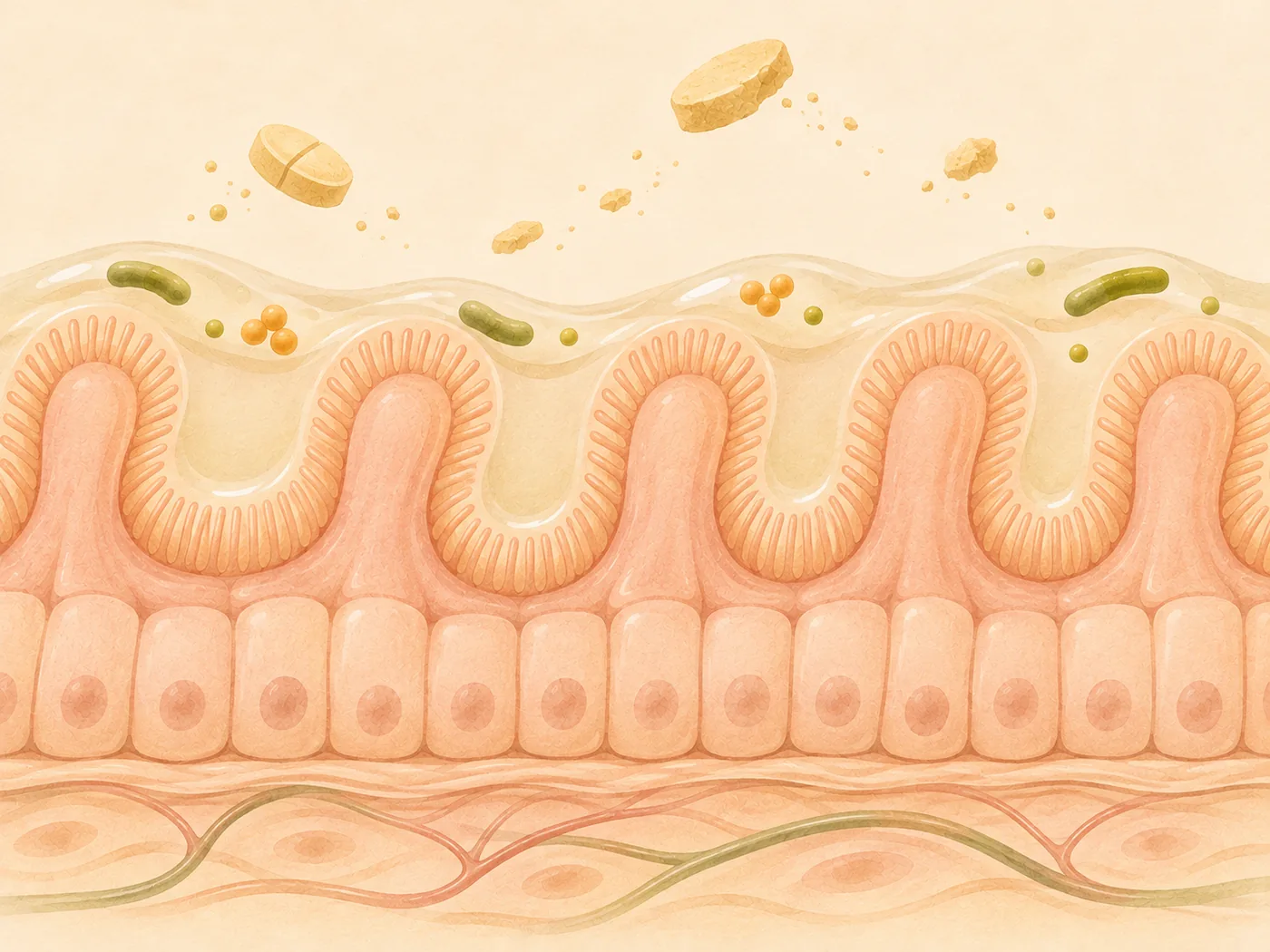
    The dog has a bacterial infection. The veterinary practice prescribes an antibiotic. It fights the bacteria that cause the illness.

    Right and important
  2. Beneficial bacteria disappear too
    2 Gut

    Beneficial bacteria disappear too

    The antibiotic does not distinguish between disease-causing and beneficial bacteria. Many gut bacteria are lost as well. Normally they produce butyrate, the most important source of energy for the gut cells. Without it, the protective mucus layer becomes thinner.

    Unfavourable for the gut
  3. The defences raise the alarm

    The defences raise the alarm

    Unwanted germs can settle in the gaps that have opened up. The immune cells in the gut wall react to this. Soft stools or diarrhoea are often the visible result.

    Unpleasant, but a protective reaction
  4. Rebuilding begins

    Rebuilding begins

    The remaining beneficial bacteria multiply again. Fibre from the food is their nourishment, protein provides the building material for new gut cells. The gut wall renews itself every few days anyway.

    Good: the gut repairs itself
  5. Back in balance

    Back in balance

    The gut flora is diverse again, the mucus layer dense, and the defences calm down. Stools, appetite and energy return to normal.

    Good: the interplay is right again
More everyday examples

How the body works in other situations.

From knowledge to practice

Two tools for everyday life

How these pages are meantThe knowledge pages explain general connections as described in scientific studies. For questions about your own dog, in case of complaints or changes, the veterinary practice is the right point of contact.