
Nutrition: what ends up in the bowl shapes the whole dog.
Food provides energy and the building materials for every cell. At the same time, it determines which gut bacteria thrive – and therefore how well the gut wall and the defences work.

The essentials in 30 seconds
- 1
The dog absorbs protein, fat and carbohydrates itself in the small intestine.
- 2
Fibre travels on to the large intestine, where it is the food of the beneficial bacteria.
- 3
A change of food alters the gut flora within a few days – so always switch gradually.
Who gets what? The paths of nutrients
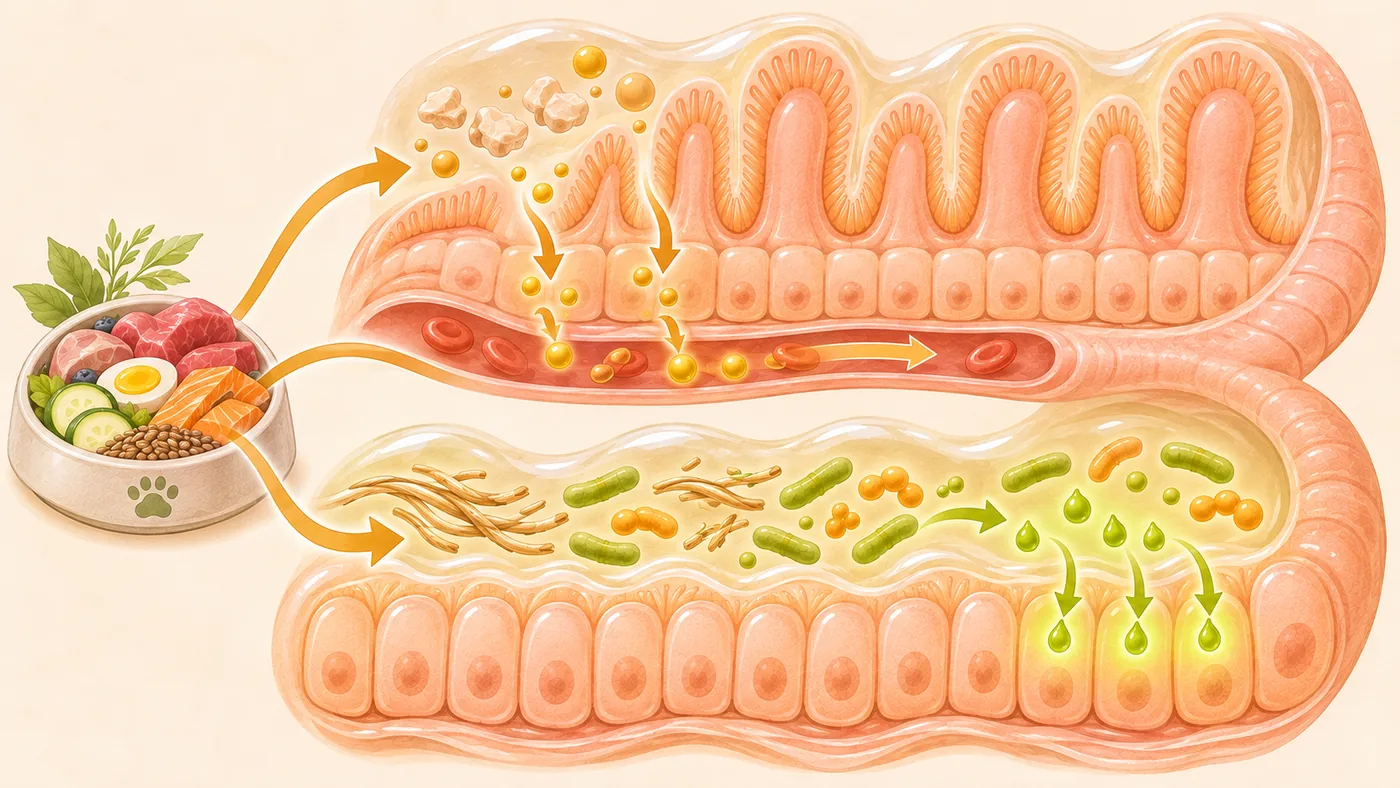
What is in the bowl takes different paths in the gut. The image shows the small intestine at the top and the large intestine at the bottom:
- Protein: it is broken down into amino acids and absorbed into the blood in the small intestine. Amino acids are the building blocks for muscles, skin, coat, gut cells, immune cells and antibodies.
- Fat: it provides a lot of energy and brings the fat-soluble vitamins A, D, E and K with it. Fat is also absorbed in the small intestine.
- Carbohydrates: starch from potatoes, rice or grain is broken down into sugar and provides quick energy.
- Fibre: the dog cannot digest it. It travels on to the large intestine, where the bacteria ferment it. This produces short-chain fatty acids such as butyrate – the green drops in the image – which nourish the gut cells1.
- Vitamins and minerals: they are only needed in small amounts, but are necessary for almost every process in the body, including the work of the immune cells.
Fibre: the food of the gut bacteria
Fibre consists of plant components. It is found in vegetables, fruit, potatoes and grain, but also in seed husks such as psyllium husks. Meat, offal and fish contain none. That is why every meat ration should also include plant ingredients.
- Highly fermentable fibre: it is the most valuable food for the gut bacteria. This includes pectin from apples, carrots and pumpkin, inulin from chicory root and resistant starch, which is only broken down in the large intestine. In a laboratory test with dog faeces, citrus and beet pectin were among the most fermentable fibres2,3. Resistant starch promoted the beneficial bacterium Faecalibacterium in dogs4.
- Poorly fermentable fibre: it hardly nourishes the bacteria, but makes the stool firmer. This includes cellulose from peels, stalks and leafy vegetables3,5.
The amount matters. Very small amounts had no effect: 0.2 to 0.4 % inulin in the food did not change the gut flora6. More had an effect: 7.5 % beet pulp in the food measurably changed the composition of the gut flora7. In dogs fed fresh food, more fibre was associated with a better dysbiosis index – a laboratory measure of the balance of the gut flora, where lower is better8.
Too much is not good either: the more oligofructose (a fibre similar to inulin) the dogs received, the softer their stools became9. So increase fibre gradually and keep an eye on the stool.
What nutrition provides for defence and repair
- Building material: every repair needs protein, because new cells consist largely of it. Immune cells and antibodies are also made of protein.
- Micronutrients: zinc and vitamins A, D and E are involved in the work of the immune cells and in wound healing. If they are lacking, defence and repair work less well.
- Protective antibodies in the gut: fermentable fibre increased the amount of IgA in the stool of dogs10,11 – the antibody that catches germs before they reach the gut wall.
- Phagocytes: with 1 % galacto-oligosaccharides (GOS, a prebiotic) in the food, the phagocytes in the blood test took up more bacteria and neutralised them more effectively12.
- Energy for the gut wall: the butyrate that the bacteria form from fibre supplies the gut cells, which renew themselves constantly1.
Why a change of food should be gradual
A new food is in the bowl in a second – the gut needs much longer. After an abrupt change, the gut flora and its metabolic products changed strongly at once; the gut flora only settled into a new balance after about six days13. Within eight days, the pancreas did not adapt its digestive enzymes to a food richer in fat or carbohydrates14.
An abrupt change is unfavourable: in healthy dogs it triggered a temporary dysbiosis with softer stools and raised inflammation markers15. A gradual switch is good: over seven days it lowered the risk of diarrhoea in puppies and promoted beneficial gut bacteria16. Incidentally, the changes caused by a change of food are reversible17.
- How to do it: mix in a little more of the new food each day over at least seven days until it completely replaces the old one.
- Warning signs: soft stools, diarrhoea, flatulence, vomiting or loss of appetite – then go back one step and stay longer at each step.
What matters in the ration
- Fresh and minimally processed: gently cooked food was well digested in studies18, and family dogs fed this way had firmer stools and a more diverse gut flora19.
- Rich in fibre: more fibre was associated with a more favourable balance of the gut flora8.
- Calculated to meet requirements: in 167 dogs with an individually calculated home-cooked ration plan, the owners frequently reported improved symptoms and a nicer coat after an average of 14 months20. What matters is that the ration contains every nutrient in the right amount.
- Careful hygiene: raw meat can contain pathogens and resistant germs. Clean work surfaces and thorough hand washing protect dog and human21.
The nutrient calculator works out how much of each ingredient your dog needs – accurate to the gram.
Terms briefly explained
- Amino acids
- The building blocks of protein. From them, the body builds muscles, cells, immune cells and antibodies.
- Fibre
- Plant food components that the dog cannot digest itself. In the large intestine, the bacteria make use of them.
- Fermentable
- Fibre that gut bacteria can break down well. This produces beneficial short-chain fatty acids.
- Short-chain fatty acids
- Acetate, propionate and butyrate: metabolic products of the gut bacteria that supply the gut wall and dampen inflammation.
- Prebiotics
- Fibres that specifically feed beneficial gut bacteria, for example inulin or GOS.
- Dysbiosis index
- A laboratory test from a stool sample that assesses the balance of the gut flora. Lower is better.
What studies show: the sources
The superscript numbers in the text refer to these studies. All details have been verified via their DOI and lead to the original publication.
- Characterization of fecal bacterial populations in canines: effects of age, breed and dietary fiber. (2002). DOI: 10.1007/s00248-002-0001-z
- Fruit and vegetable fiber fermentation by gut microflora from canines. (2001). DOI: 10.2527/2001.794919x
- Organic matter disappearance and production of short- and branched-chain fatty acids from selected fiber sources used in pet foods by a canine in vitro fermentation model1. (2019). DOI: 10.1093/jas/skz302
- Graded dietary resistant starch concentrations on apparent total tract macronutrient digestibility and fecal fermentative end products and microbial populations of healthy adult dogs. (2021). DOI: 10.1093/jas/skaa409
- Effects of dietary cellulose on clinical and gut microbiota recovery in dogs with uncomplicated acute diarrhea: a randomized prospective clinical trial. (2025). DOI: 10.2460/javma.24.07.0476
- Low-level fructan supplementation of dogs enhances nutrient digestion and modifies stool metabolite concentrations, but does not alter fecal microbiota populations (2009). DOI: 10.2527/jas.2008-1659
- Phylogenetic characterization of fecal microbial communities of dogs fed diets with or without supplemental dietary fiber using 454 pyrosequencing. (2010). DOI: 10.1371/journal.pone.0009768
- Effects of diet type on the core fecal bacterial taxa and the dysbiosis index of healthy adult dogs. (2025). DOI: 10.3389/fvets.2025.1572875
- A dose-response experiment evaluating the effects of oligofructose and inulin on nutrient digestibility, stool quality, and fecal protein catabolites in healthy adult dogs (2003). DOI: 10.2527/2003.81123057x
- The effect of age and carbohydrate and protein sources on digestibility, fecal microbiota, fermentation products, fecal IgA, and immunological blood parameters in dogs. (2017). DOI: 10.2527/jas.2016.1302
- Consumption of identically formulated foods extruded under low and high shear force reveals that microbiome redox ratios accompany canine immunoglobulin A production. (2020). DOI: 10.1111/jpn.13419
- Galactoligosaccharide and a prebiotic blend improve colonic health and immunity of adult dogs (2020). DOI: 10.1371/journal.pone.0238006
- Longitudinal fecal microbiome and metabolite data demonstrate rapid shifts and subsequent stabilization after an abrupt dietary change in healthy adult dogs. (2022). DOI: 10.1186/s42523-022-00194-9
- Absence of rapid adaptation of the exocrine pancreas of conscious dogs to diets enriched in fat or carbohydrates. (1996). DOI: 10.1076/apab.104.7.819.13105
- Impact of an abrupt change from dry to canned diet on digestive function and gut microbiota in dogs. (2025). DOI: 10.1093/jas/skaf143
- Abrupt Dietary Change and Gradual Dietary Transition Impact Diarrheal Symptoms, Fecal Fermentation Characteristics, Microbiota, and Metabolic Profile in Healthy Puppies. (2023). DOI: 10.3390/ani13081300
- A diet change from dry food to beef induces reversible changes on the faecal microbiota in healthy, adult client-owned dogs. (2017). DOI: 10.1186/s12917-017-1073-9
- Nutrient digestibility and fecal characteristics, microbiota, and metabolites in dogs fed human-grade foods. (2021). DOI: 10.1093/jas/skab028
- Diet-induced metabolic and faecal microbiome responses in pet dogs fed a minimally processed versus extruded kibble diet. (2026). DOI: 10.3389/fvets.2026.1734572
- Homemade Diet as a Paramount for Dogs' Health: A Descriptive Analysis. (2024). DOI: 10.3390/vetsci11090438
- Presence of pathogenic bacteria in faeces from dogs fed raw meat-based diets or dry kibble. (2020). DOI: 10.1136/vr.105644