
Health & recovery: how the body protects and repairs itself.
A body is not healthy because nothing ever happens to it, but because it compensates well for strain. In every repair, the immune cells set the pace.

The essentials in 30 seconds
- 1
When the interplay is right, you can see it in digestion, skin, coat and energy.
- 2
Every repair takes place in four phases: alarm, defence, clean-up, renewal.
- 3
Inflammation is useful at first. It becomes unfavourable when it no longer subsides.
How to recognise a good interplay
Gut, nutrition and immune system work behind the scenes. But whether they work well together shows in everyday life:
- Digestion: formed stools, regular bowel movements, hardly any flatulence.
- Skin and coat: shiny coat, no itching. Gut and skin are closely connected: dogs with allergic skin inflammation had an altered gut flora, and in one study a change in the gut flora was associated with better skin symptoms1,2.
- Weight: stable and suited to the build. Overweight dogs had a less diverse gut flora and signs of low-grade inflammation3.
- Energy and behaviour: appetite, playfulness and stamina. Via the gut-brain axis, gut flora, immune system and nervous system are in constant exchange4.
The four phases of repair
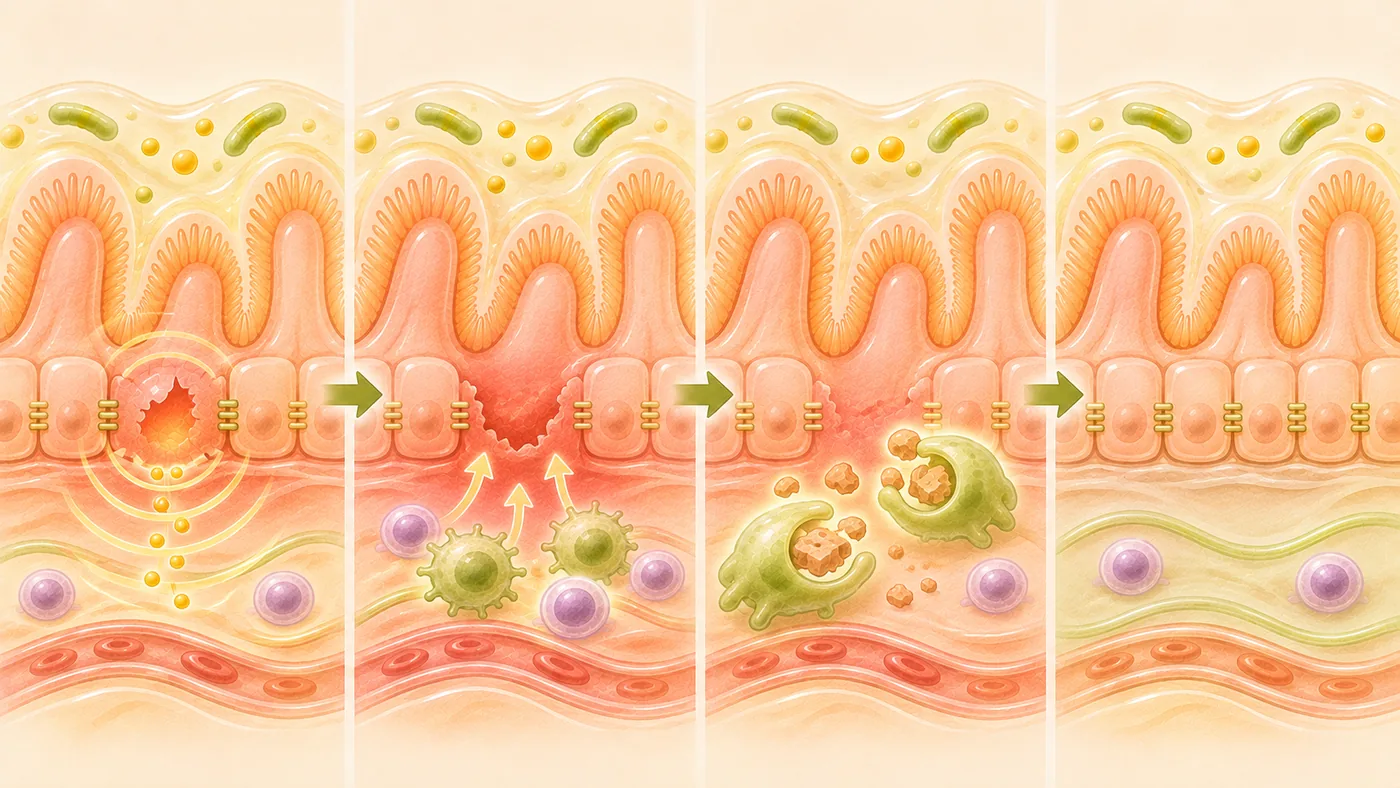
Whether it is an infection, a minor injury or an irritated gut wall: the body repairs according to the same programme. The image shows the four phases from left to right:
- 1 Alarm: damaged cells and sentinel cells release messenger substances (technical term: cytokines). The blood vessels widen and blood flow to the area increases. That is why it becomes warm, red and swollen. In the gut, diarrhoea can be part of this – it flushes out intruders. This is inflammation, and here it is useful.
- 2 Defence: within hours, fast phagocytes migrate in from the blood and fight the germs. If a pathogen persists, the learning defence joins in with matching antibodies.
- 3 Clean-up: large phagocytes take up germ remains and dead cells. Then they switch over: instead of raising the alarm, they send signals that end the inflammation. Regulatory T cells additionally slow down the defence.
- 4 Renewal: new cells grow back and close the gap. In the gut wall, stem cells deep in the mucous membrane divide for this – which happens particularly quickly, often within a few days.
It is good when the whole programme is completed after a few days. The area is then tight and calm again, as if nothing had happened.
When inflammation does not subside
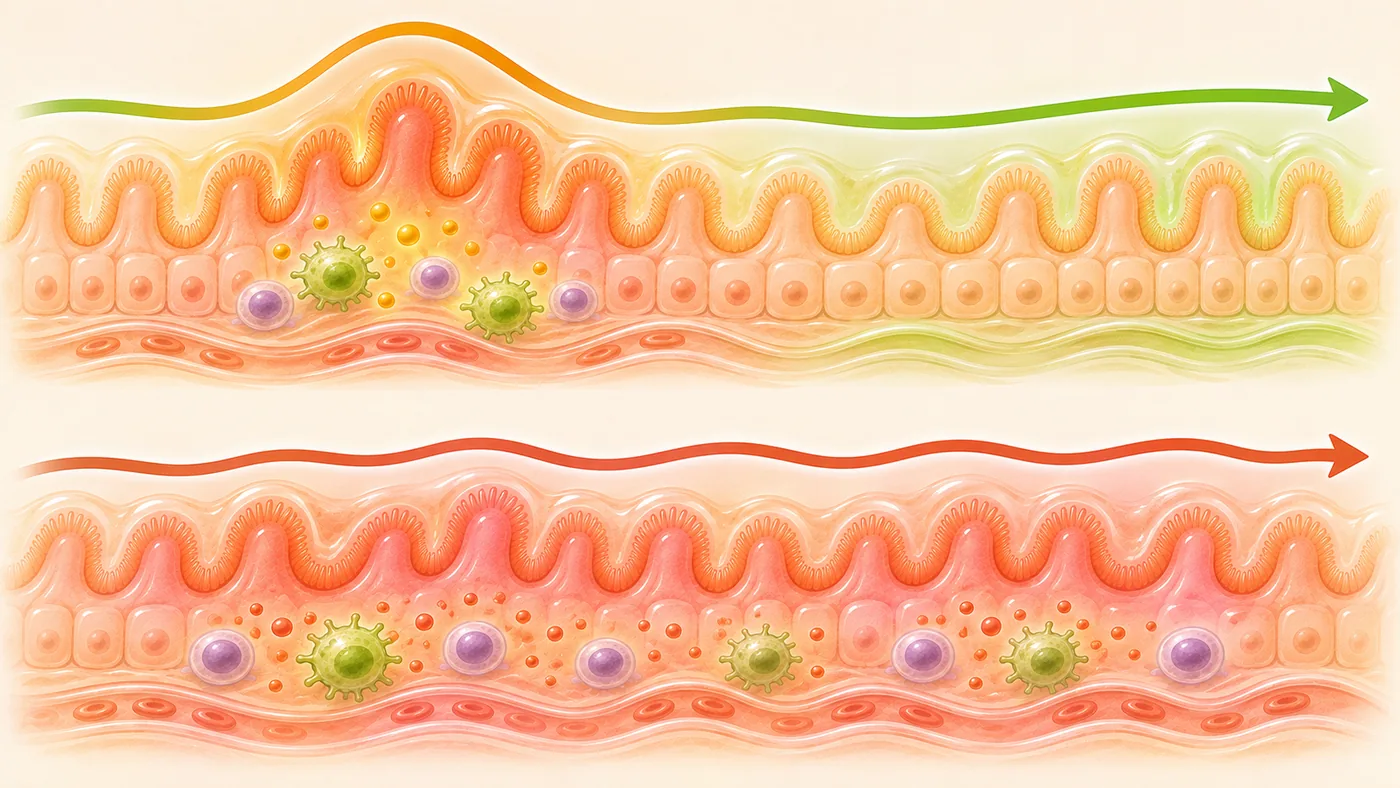
The image shows the difference: at the top a short (acute) inflammation that rises quickly and subsides again. At the bottom a long-lasting (chronic) inflammation that never really ends.
- What goes wrong: switching off in phase 3 does not work. The immune cells remain in alarm mode, the gut wall stays leaky – and new stimuli get through the gaps and fuel the inflammation further.
- In dogs, the condition is called chronic inflammatory enteropathy (technical term: CIE, formerly IBD). In 2026, the American College of Veterinary Internal Medicine published uniform guidelines on diagnosis and treatment5.
- Measurable: the inflammatory substance calprotectin was raised in the intestinal lining of affected dogs, and the more so, the more the lining was altered6. A high level of a related substance in the stool (S100A12) was associated with a poorer response to treatment7.
The good news: the defences can calm down again. After successful treatment, the ratio of phagocytes in the gut wall returned to normal8. And in many dogs with chronic intestinal inflammation it turned out in the long term that a suitable change of diet was sufficient9.
What supports recovery
- Building material: new cells, immune cells and antibodies consist of protein. A balanced ration also provides zinc and vitamins A, D and E.
- Energy for the gut wall: butyrate from fibre supplies the gut cells, which divide particularly quickly during repair10.
- Rest: chronic stress changes stress hormones and the gut flora11. Sleep and a calm daily routine give the body strength for repair.
- Time: after strain, the gut flora often needs weeks. After metronidazole, it was altered in healthy dogs for at least four weeks12.
Terms briefly explained
- Inflammation
- The body's alarm and repair programme. Typical signs: warmth, redness, swelling, pain.
- Acute
- Sudden and of short duration. Acute inflammation subsides again after a few days.
- Chronic
- Long-lasting or recurring. Chronic inflammation does not subside on its own.
- Cytokines
- Messenger substances with which immune cells and other cells communicate, for example to raise the alarm or give the all-clear.
- Stem cells
- Cells from which new body cells arise. In the gut wall they ensure a constant supply.
- CIE
- Chronic inflammatory enteropathy in dogs, formerly called IBD.
- Calprotectin
- A substance from immune cells that occurs in greater amounts in intestinal inflammation. It is measured as an inflammation marker.
What studies show: the sources
The superscript numbers in the text refer to these studies. All details have been verified via their DOI and lead to the original publication.
- A comprehensive analysis of gut and skin microbiota in canine atopic dermatitis in Shiba Inu dogs. (2023). DOI: 10.1186/s40168-023-01671-2
- Probiotics ameliorate atopic dermatitis by modulating the dysbiosis of the gut microbiota in dogs (2025). DOI: 10.1186/s12866-025-03924-6
- Association of obesity with serum leptin, adiponectin, and serotonin and gut microflora in beagle dogs. (2015). DOI: 10.1111/jvim.12455
- Bidirectional Communication: The Gut-Brain Axis in Companion Animal Health. (2026). DOI: 10.1016/j.cvsm.2026.01.008
- ACVIM–endorsed statement: consensus statement and systematic review on guidelines for the diagnosis and treatment of chronic inflammatory enteropathy in dogs (2026). DOI: 10.1093/jvimsj/aalaf017
- Duodenal and colonic mucosal S100A8/A9 (calprotectin) expression is increased and correlates with the severity of select histologic lesions in dogs with chronic inflammatory enteropathy (2024). DOI: 10.1186/s12917-024-04256-9
- Fecal S100A12 concentration predicts a lack of response to treatment in dogs affected with chronic enteropathy. (2016). DOI: 10.1016/j.tvjl.2016.03.001
- Changes in duodenal CD163-positive cells in dogs with chronic enteropathy after successful treatment. (2018). DOI: 10.1177/1753425918799865
- Long-term evaluation of the initial response to therapy in 60 dogs with chronic inflammatory enteropathy. (2024). DOI: 10.1111/jvim.17161
- Characterization of fecal bacterial populations in canines: effects of age, breed and dietary fiber. (2002). DOI: 10.1007/s00248-002-0001-z
- Linking shelter conditions to health: A multisystem analysis of stress, metabolism, and fecal microbiota in dogs. (2026). DOI: 10.1371/journal.pone.0350401
- Effects of metronidazole on the fecal microbiome and metabolome in healthy dogs. (2020). DOI: 10.1111/jvim.15871