
The immune system: a team of immune cells.
The immune system is the body's own defence. It consists of different immune cells that share the work like a well-coordinated team. A large part of them sits in the gut wall.

The essentials in 30 seconds
- 1
Immune cells recognise intruders, fight them and clean up afterwards.
- 2
There is a fast first-line defence and a learning defence that remembers pathogens.
- 3
In the gut, the immune cells learn to tolerate food and beneficial bacteria.
The team of immune cells
Each immune cell has its own task. Only together do they form an effective defence:
- Sentinel cells (dendritic cells): they sit in the gut wall, take samples of everything that passes by and report anything suspicious to the other immune cells.
- Fast phagocytes (neutrophil granulocytes): they are the first to arrive from the blood at the scene and take up germs.
- Large phagocytes (macrophages): they eat germs and dead cells, clean up and then give the signal for repair.
- B cells: they form antibodies – proteins that fit exactly to a particular pathogen and mark it. In the gut, this is above all the protective antibody IgA.
- T helper cells: they direct the response and call in the appropriate immune cells.
- Killer T cells: they recognise body cells infected by viruses and destroy them.
- Regulatory T cells: they slow down the defence when it is no longer needed. Without them, inflammation would not end.
- Memory cells: they remember a pathogen. At the next contact, the defence reacts faster and more strongly.
Two lines of defence: fast and learning
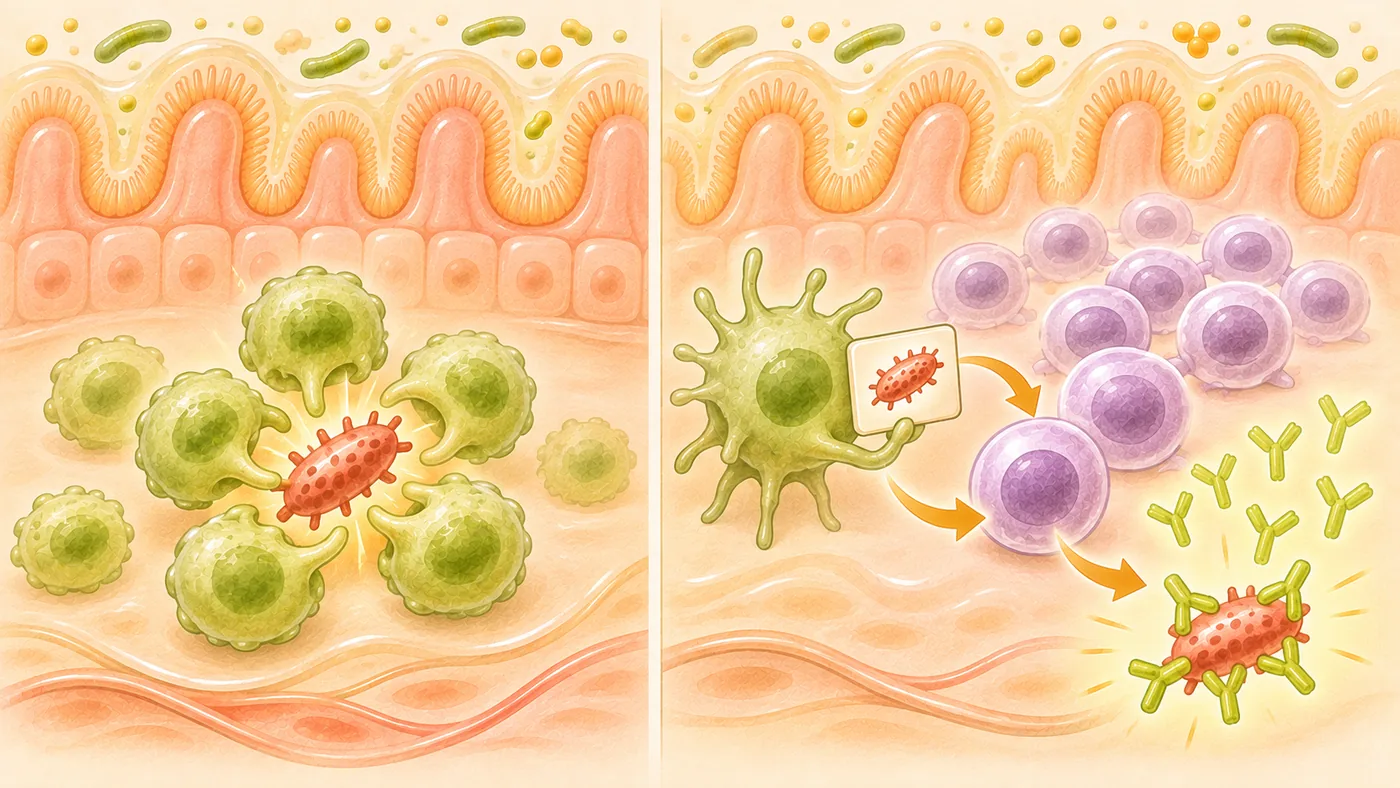
The immune system works with two lines of defence that complement each other1:
- The fast first-line defence (image left, technical term: innate immunity): it is ready for action immediately and reacts to anything typical of pathogens. Phagocytes surround the intruder within hours.
- The learning defence (image right, technical term: adaptive immunity): a sentinel cell shows the T and B cells a “wanted poster” of the pathogen. Then exactly the matching cells multiply and form antibodies that fit only this pathogen. At first contact this takes a few days – after that it remembers the pathogen.
Good: thanks to the memory of the learning defence, a dog falls ill with many pathogens only once or not at all.
The gut as a school for the defences
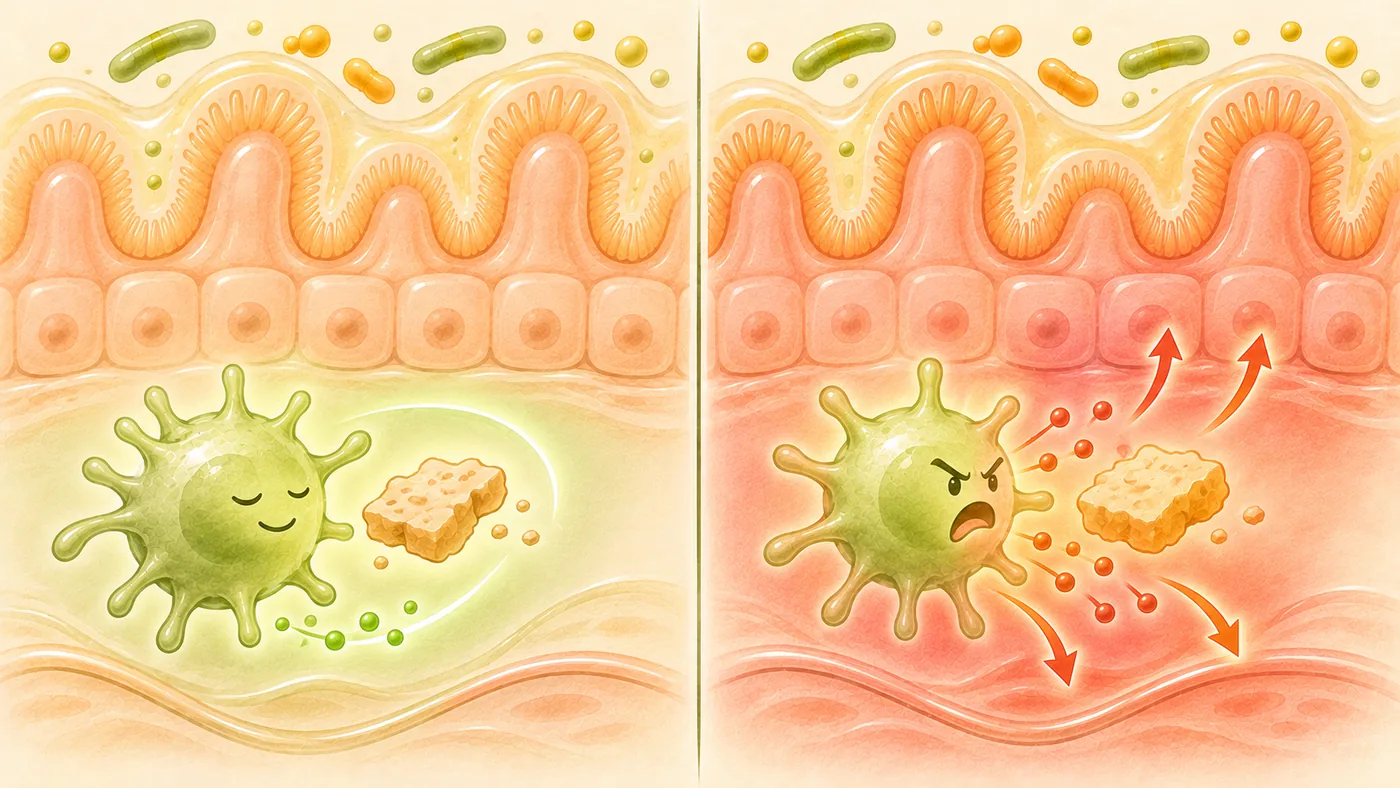
In the gut, the immune cells encounter huge amounts of food and bacteria every day. If they reacted to everything, the gut would be constantly inflamed. That is why they learn something special here: tolerance.
- Good – tolerance (image left): the immune cell meets a harmless food particle and stays calm. The gut bacteria help it to recognise what is harmless.
- Unfavourable – false alarm (image right): the immune cell classifies a harmless food particle as dangerous and fights it. This is how a food allergy develops. Dogs with intestinal diseases had more antibodies against food components in their blood2. A food intolerance is something different: the immune system is not involved, for example when lactose (milk sugar) is poorly digested.
The protective antibody IgA coats bacteria in the gut. In dogs with chronic intestinal inflammation, more bacteria were coated with antibodies, and their proportion fell again when the dogs got better3 – a sign that the defences in the gut can calm down again.
The skin is connected too: dogs with allergic skin inflammation (atopic dermatitis) had an altered and less diverse gut flora4,5.
Immune cells also direct the repair
Immune cells not only fight pathogens, they also direct healing. The large phagocytes are the key figures: first they eat germs and debris, then they switch over and send signals that end the inflammation and stimulate the regrowth of new cells. At the same time, the regulatory T cells slow down the defence.
This can be observed in dogs: in dogs with chronic intestinal disease, the phagocytes in the gut wall were shifted; after successful treatment their ratio returned to normal6. How the repair proceeds step by step is explained on the health & recovery page.
What the defences do against Giardia
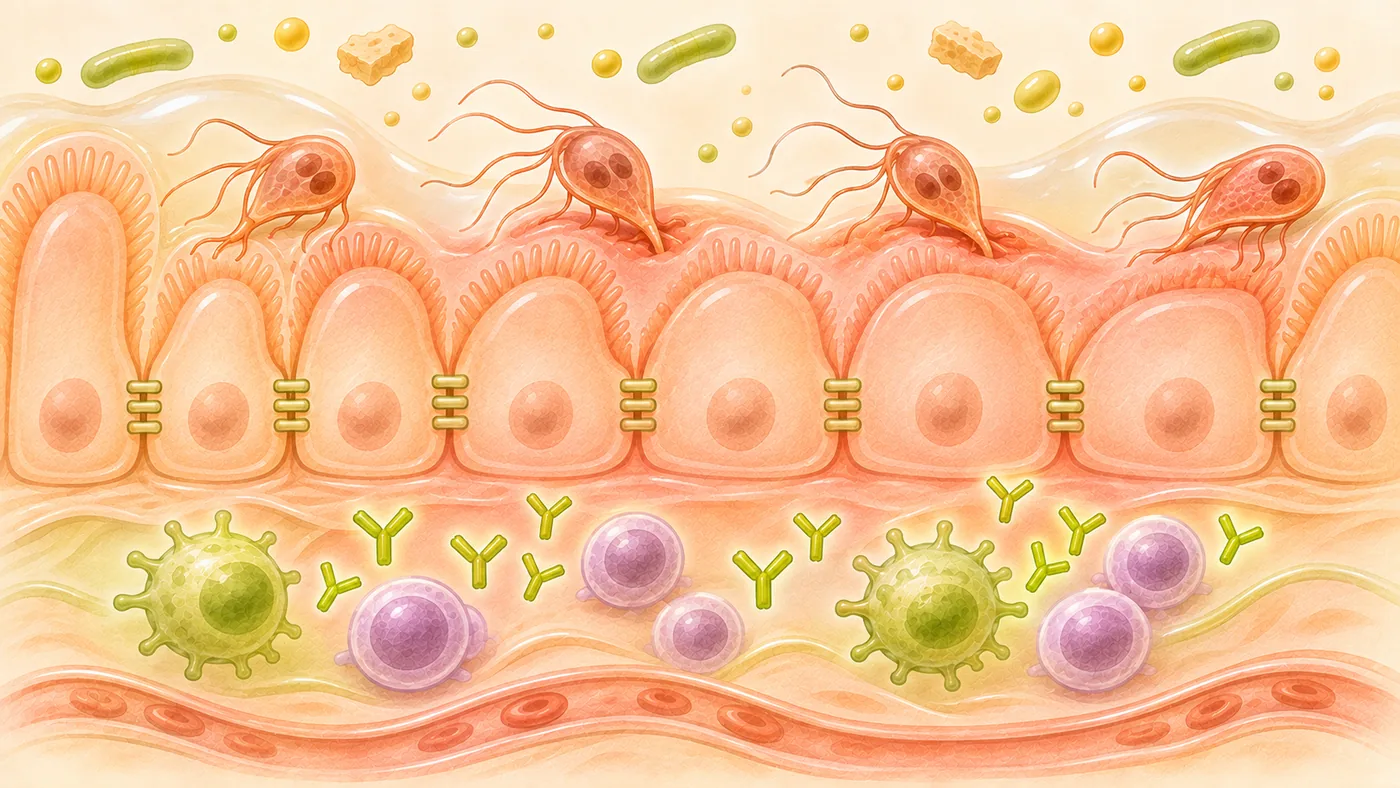
Giardia are single-celled parasites. Dogs pick them up from contaminated water or faeces. In the small intestine, they attach themselves to the surface of the gut wall. In a laboratory experiment, a protein released by Giardia loosened the connections between gut cells and damaged the cell layer7.
- Recognising: sentinel cells take up components of the Giardia and pass the information on.
- Marking: B cells form antibodies, above all IgA, which attach to the Giardia (the Y-shaped symbols in the image).
- Cleaning up and repairing: phagocytes take up parasites and cell debris, and the gut wall renews itself.
Interesting: in dogs with Giardia, the gut flora hardly differed between dogs with and without diarrhoea. So the gut flora does not seem to be the decisive factor in whether a dog develops symptoms8.
Probiotics have also been studied, with differing results: Lactobacillus johnsonii reduced the shedding of Giardia cysts9, Enterococcus faecium SF68 showed no effect10. The treatment itself is handled by the veterinary practice; afterwards the gut wall recovers as described on the gut page.
What supports the immune cells
- Fermentable fibre: it increased the amount of protective antibodies (IgA) in the stool of dogs11,12.
- Prebiotics: with 1 % GOS in the food, the phagocytes worked more effectively in the blood test13.
- A balanced ration: immune cells and antibodies consist of protein and need zinc as well as vitamins A, D and E.
- Less stress: chronic stress changes stress hormones and the gut flora14 and thus also the environment in which the immune cells work.
Terms briefly explained
- Antibodies
- Proteins formed by B cells. Each antibody fits exactly to one pathogen and marks it for the phagocytes.
- IgA
- The protective antibody of the mucous membranes. In the gut, it catches germs before they reach the gut wall.
- Macrophages
- Large phagocytes. They eat germs and cell debris and then initiate repair.
- Neutrophil granulocytes
- Fast phagocytes that are the first to arrive at an inflammation.
- Dendritic cells
- Sentinel cells that take samples and show the other immune cells what to look for.
- T cells and B cells
- The cells of the learning defence. T cells direct the response and destroy infected cells, B cells form antibodies.
- Tolerance
- The ability of the defences to leave harmless things such as food or beneficial bacteria alone.
- Allergy
- A false alarm: the defences react to a harmless substance as if it were dangerous.
What studies show: the sources
The superscript numbers in the text refer to these studies. All details have been verified via their DOI and lead to the original publication.
- Elucidating the Role of Innate and Adaptive Immune Responses in the Pathogenesis of Canine Chronic Inflammatory Enteropathy—A Search for Potential Biomarkers (2022). DOI: 10.3390/ani12131645
- Serum IgE and IgG responses to food antigens in normal and atopic dogs, and dogs with gastrointestinal disease. (2003). DOI: 10.1016/s0165-2427(03)00033-3
- Hierarchical modelling of immunoglobulin coated bacteria in dogs with chronic enteropathy shows reduction in coating with disease remission but marked inter-individual and treatment-response variability. (2021). DOI: 10.1371/journal.pone.0255012
- A comprehensive analysis of gut and skin microbiota in canine atopic dermatitis in Shiba Inu dogs. (2023). DOI: 10.1186/s40168-023-01671-2
- Probiotics ameliorate atopic dermatitis by modulating the dysbiosis of the gut microbiota in dogs (2025). DOI: 10.1186/s12866-025-03924-6
- Changes in duodenal CD163-positive cells in dogs with chronic enteropathy after successful treatment. (2018). DOI: 10.1177/1753425918799865
- Expression and secretion of the Giardia duodenalis variant surface protein 9B10A by transfected trophozoites causes damage to epithelial cell monolayers mediated by protease activity. (2017). DOI: 10.1016/j.exppara.2017.06.006
- Giardiasis and diarrhea in dogs: Does the microbiome matter? (2024). DOI: 10.1111/jvim.16894
- Impact of Lactobacillus johnsonii CNCM I-4884 on canine giardiasis: a probiotic-based approach. (2025). DOI: 10.1186/s13071-025-07166-3
- Influence of Enterococcus faecium SF68 probiotic on giardiasis in dogs. (2009). DOI: 10.1111/j.1939-1676.2009.0283.x
- The effect of age and carbohydrate and protein sources on digestibility, fecal microbiota, fermentation products, fecal IgA, and immunological blood parameters in dogs. (2017). DOI: 10.2527/jas.2016.1302
- Consumption of identically formulated foods extruded under low and high shear force reveals that microbiome redox ratios accompany canine immunoglobulin A production. (2020). DOI: 10.1111/jpn.13419
- Galactoligosaccharide and a prebiotic blend improve colonic health and immunity of adult dogs (2020). DOI: 10.1371/journal.pone.0238006
- Linking shelter conditions to health: A multisystem analysis of stress, metabolism, and fecal microbiota in dogs. (2026). DOI: 10.1371/journal.pone.0350401